◆ RESOURCES · BLOG
Agentic Finance Does Not Fail for Lack of Agents.
This is officially the wild west of data. Models showed up faster than the habits underneath them, and too many teams are treating a confident answer as if it were a correct one.
The gap is governance, not model IQ
The risk is not that agents fail to sound smart. It's that they move work forward on contested numbers, with no trail and no limits. That kind of autonomy is not ready for month-end close, the board, or the audit committee.
People who do not really understand how data works are dropping AI onto spreadsheets, exports, and three competing versions of the same number. That is a surefire way to actualize inaccurate data: the answer looks finished, so the argument looks settled, even when the definition was never owned and the trail was never kept. Agentic AI is already past the side demo. It is clearing reconciliations, chasing cash, and running controls with less human touch. McKinsey's State of Organizations 2026 puts a hard number on the gap: 88 percent of organizations are now experimenting with AI, and 81 percent do not report any meaningful bottom-line gains. That is not a model shortage. Models are abundant. What is scarce is a finance function that can let AI act inside month-end close, treasury, and controls without losing the transparency boards and regulators now expect.
This is the same pattern we have written about as analytics technical debt and as production rules for Enterprise Analytics AI. AI does not invent trust. It amplifies the condition of the system beneath it. For finance, that system has to be accountable before it is autonomous.
A compressed cycle demands earlier grounding
One reason the gap feels so sharp is speed. The AI lifecycle is moving much faster than earlier technology waves. In the internet and dot-com years, hype, implementation, and real adoption had years of lag between them. Companies could stumble, recover, and still catch the curve. Generative and agentic AI compress that sequence. The model is a commodity. Access is cheap. Demos look finished in an afternoon. The window to get grounded, before confident answers harden into operating truth, is shorter than most finance teams expect.
That compression is why readiness cannot wait for a two-year platform program. Leaders need a framework that helps the organization trust earlier: owned definitions, evidence on the path, and bounded action before autonomy expands. Sherpa AI is built for that grounding layer. Not another place to ask a clever question. A practical route to implement and stand behind AI in the workflows that actually matter, while the adoption curve is still moving under your feet.
Certified metrics, not chatbot answers
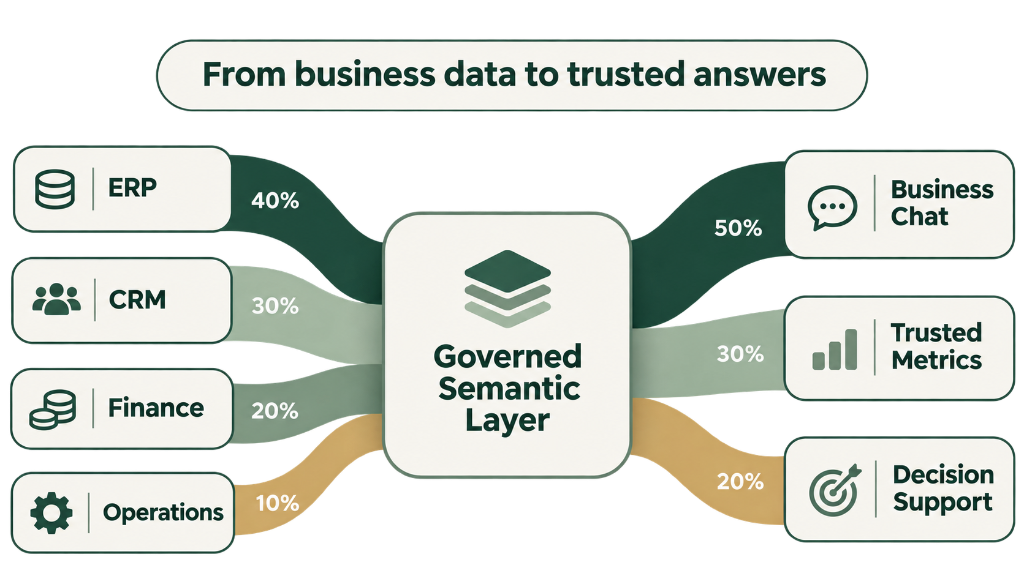
The first design choice is deceptively simple. AI that touches finance should reason from certified metrics, not from whatever table looks plausible in the moment. A certified metric has a written definition, a named owner, known sources, and a known as-of. Revenue means one thing. Unpaid means one thing. Cash available means one thing. When those sentences live in people's heads or in three competing workbooks, every agent becomes a reconciliation project with better prose.
This is not pedantry. Month-end already spends too much time arguing which version of the number is real. An agent that picks a definition without ownership does not accelerate the close. It relocates the argument into a chat transcript that nobody wants to reconstruct later. Finance leaders who want agentic workflows should start by asking a colder question: which metrics are we willing to put our name on, and which ones are still tribal knowledge wearing a dashboard costume?
Audit as a byproduct of the run
The second design choice is that the evidence trail cannot be a separate project after the pilot works. If audit requires a lake nobody reads, it will not happen when the quarter is on fire. Useful audit is automatic. Each run records who asked, which definition was used, which sources were queried, what was refused, and what action was proposed or taken. Enough to reconstruct what the system knew when it acted.
That is lineage and explainability at the level boards actually care about. Not a film of every keystroke. A defensible path: this reconciliation exception, this remittance watch, this control check used this metric, from these sources, under these permissions. When something looks wrong, finance can answer three questions without a war room. What definition was used? What sources were queried? Who approved automation at this scope?
Bounded agents, earned autonomy
The third design choice is how far an agent is allowed to go. Autonomy should be earned, not assumed. A useful agent gathers context, evaluates it against the business, and either acts inside a narrow permission or escalates with evidence. High-impact judgment stays with people until the system has proven it can operate inside the workflow, not around it.
That progression matters for finance more than for almost any other function. Gathering and recommending on a margin exception is one kind of risk. Writing to a ledger, releasing cash, or changing a customer record is another. The closer an action gets to irreversible money movement, the stronger verification and human approval must become. Governance here is not a binder that slows the project. It is the set of boundaries that lets leadership expand autonomy without inventing a committee for every release.
Three questions before the next pilot
If you are past the pilot stage and need a real playbook, start with three questions you can take into the next audit-committee prep. Do we have certified finance metrics with owners, or competing versions of the truth? Can we reconstruct what an agent knew when it acted? Where does autonomy stop, and who owns the exception when judgment is required?
Those questions are how Sherpa AI approaches Enterprise Analytics AI for finance leaders. An operating layer under the model: one place for trusted context, agreed definitions, verification on the path, and agents that gather, evaluate, and act inside limits people can stand behind. Autonomous becomes useful only when accountable is already designed in.
If you want a compact way to pressure-test readiness before the next model contract, use the High Ground Brief. It is a six-layer scorecard for whether the layer under AI can hold. Or bring us one finance process you want to make more autonomous without losing the trail. That conversation is usually more valuable than another demo of fluency.
◆ YOUR NEXT STEP
Start with the layer under the agent.
Bring us one finance workflow you want to make more autonomous without losing the trail. We will map the certified metrics, evidence path, and human boundaries that make agentic finance safe enough for the close.
Start a working session ↗